I thought that the correct way of measuring a power supply would always require a load.
But apart from the load, is this the right way to measure ripple?
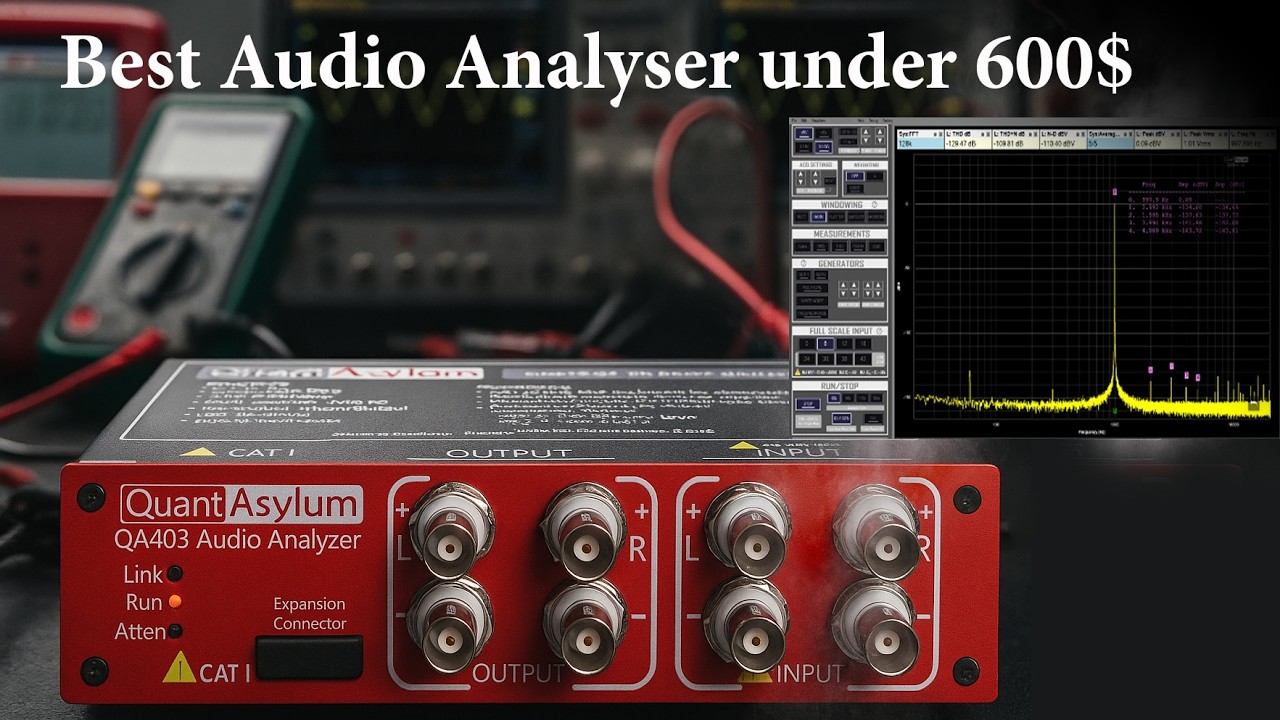
I thought that the correct way of measuring a power supply would always require a load.
But apart from the load, is this the right way to measure ripple?
Well the whole point of a power supply is to supply power so the only valid measurements would be if there is at least some current getting delivered. In these tests the current delivered by these power supplies in these tests he has conducted would be miniscule because of the high input impedance of the 403. For the results to be anywhere near valid the power supplies would need to be supplying current into a load simulating the actual devices they are powering. In addition it is advisable to measure PS noise under a range of load conditions to characterise the power supply’s performance as some power supplies often perform better under lower current drain.
Another consideration is that the standard for measuring power supply noise is to limit the measuring bandwidth to 20MHz which is well above the capability of the 403. Whilst some may argue this is out the audio range, HF (RF) significant noise on the power rails can potentially impact on digital circuitry.
I note with interest the Gabster says his add on filter is a RC type. I wonder how much d.c. voltage is dropped in his “Pro” filter under heavy current drain? He doesn’t mention this in his video, nor does he demonstrate this in the video.
I also believe that there are some flaws with this measurement. Also, the 20MHz batndwidth limit is a valid point. Honestly, I’m not sure if the QA403 is capable of PS measurements.
Power suppply measurements usually focus on noise (random) and ripple (non-random). For linear PSUs in audio devices - which the QA403 is designed for - it is very capable. Both of the above mentioned are AC measurements and, provided you don’t exceed the DC limits of the device (or use a suitable DC blocking arrangement when you do) you can accurately characterise those PSU parameters. Switch-mode PSUs are a different kettle of fish though and best attacked with high-bandwidth oscilloscopes . . .
Ripple in a linear mains PSU is directly in the audio band and thus could be measured fine with any audio analyzer - switch mode supplies produce ripple at many frequencies, mostly outside the audio band.
The white noise floor and 1/f noise of a PSU can be measured in the audio band and this is potentially useful measurement for any PSU.
PSU measurements would typically taken through a DC-blocking capacitor so (AC) attenuation is not needed.
What would be such a safe arrangement? I have linear power supplies up to 600 Volt DC that I want to measure for noise and ripple.
This filter I found on this site seems to dampen low frequencies quite a lot (50 Hz. minus 16 dB). I guess a larger value for C2 will help somewhat. What do you think?
Well its easy to calculate the FR of that, given the input impedance of the load. As drawn it has a cutoff frequency around 3.3Hz (470nF + 103.2kohms)
