Thanks for the reply. Do you have any suggestions for a stop-gap technique?
Hi @ngineer, probably there’s a I2S to USB bridge available somewhere? You could then just save the captured data as WAV and import an analyze. Not ideal, I know…
Will the switch capability between 12 and 24MHz and 20Bit to 24Bit @ I2S also come with the 2.0 Software ?
Or is this Capability Independet from that, still waiting for that feature 
Hi @Frunse, they features are independent, but it requires a firmware change, and those tend to get batched up and happen together. I don’t know when the feature will get added at this point.
Thanks
Hi,
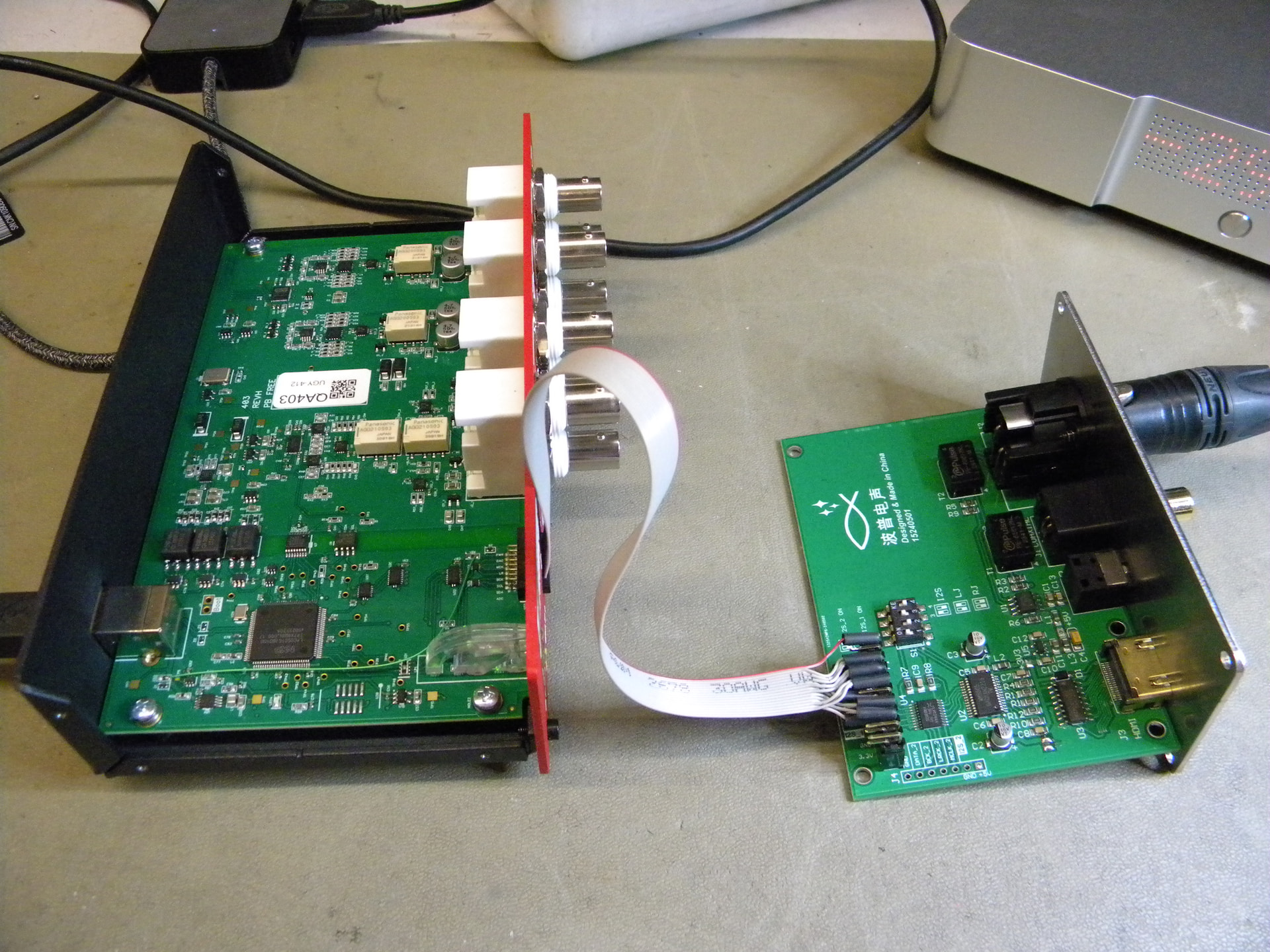
Also I succeed to connect a Audiophonic digital output board to a QA403.
I’m going for a more blunt solution without isolator and powered from the QA403 expansion connector. The board needs 5V and has it’s own LDO’s. To accomplish this i modified the QA FP_PWR pin. I removed the 10R resistor and took the 5V direct from the USB plug. The board needs 60mA.
You need the FP_I2S_ADC for data.. (Should be DAC!!)
1 Like
Your Audiophonics Board is newer than my it has dip switches to select left or right satisfied Signal!
I got 4 of this newer Boards for my HDMI to 7.1 AES Extractor, so i need to test it again with ISolator in between
But on the Other Hand i need an HDMI Out for my actual Setup with an RME HDSPe AES in and Out PC Based DSP, it get his signal from My HDMI to I2S to i2s to AES Extractor (7.1)
I have now 2 option to feed the Measuring Signal into that RME Card, Directly with AES and i need to reconect the AES Inputs for all Chanels Measuring (7.1 Input)
Or i use an I2S to HDMI on QA 403 and feed it thrue an HDMI switcher for Measuring But than i need to made an Mixer Setup to switch the Stereo inPut to all 7.1 Channels on CamillaDSP
That i need also to do if i use I2S to AES Out on QA403 to avoid reconect the AES Inputs of RME Card

You say i need to use FP_I2S_ADC on that connector for DATA? that i did not understand, on wiki it say you need to let them untouched???
So is there something Mismatched on that QA 403 Digital Out Connector?
And that why my Try with that Older I2S to AES Card won’t work from udiophonics??The Output Bitstream should be on FP_I2S_DAC now i am a bit Confused 
I could avoid to use the Digital Out if the Unsuported ASIO Driver for QA403 would work with Flex Asio so i could use my HDMI OUT on my Source PC as an OUT Device and QA403 as Input Device at once, than i could switch all 8 Chanles in REW for 7.1 Measuring to RME DSP PC.
But this won’t work for now, if i switch to Asio i can use AQ403 or FlexASIO but not Both at once and FlexASIO don’t show me QA403 Device!!!
That sucks a bit, having such nice Measuring Devices and can’t use them for now.
At the End i bought me an Zoom H-44 USB Interface thats detected by FlexASio and i can use both at once HDMI Out and U-44 for input!!!
So my Quant Asylum Stuff liying around with 2 Microphone Amps for dual Measuring with 2 Mics and i can’t use them since i bought it!!! Worthless i would say…only because off lack at Windows ASIO implementation or Wasapi or what ever…
Was not the right invest for me as an Speaker builder  at the End But my Setup is Special i guess not the Mainstream:
And i use REW the Most time and for that i bought the Wrong Measuring Device i guess, thats my Mistake and not an Mistake from Matt and QantAsylum. to be honest ;)!
After Years still no good Driver implementation for Windows, every Studio Audiointerface do it better i need to say, sorry for that!
My Project is ongoing here:
Also bought me 3 SMSL SU-2 Dacs for first Testing with that RME Card that Cost only 99$ each and gives me THD+N 123dB
XLR AES in and XLR Out so if i could use it on an QA403 Digital Out that would give me better Measuring performance i guess so Matt why still no Digital Out Board aviable from you after this Time ??? Even with 48kHz only it would help.
Hi @Frunse, the original intent of the external interface was testing dac silicon that took I2S in directly. These are usually small EVMs available from TI, Infineon and others. And as such, it usually required a board to be made to handle the voltage translation (you can see the schematic on the front panel expansion connector wiki). So, the thinking was, whatever you build, you just pull 10-20 mA from the I2S port supply and use that to power an isolator or level translator, and then the other side of that isolator is whatever circuit you want.
Beyond that (I2S master running at fixed rate), the world of serial audio gets very complicated very quickly. Additionally, the QA403 I2S plug isn’t ideal for continued plug/unplug cycles.
The QA404 moves the I2S interface to a DB9, beefs up the drive, and pulls in dedicated silicon to allow either I2S master or slave, and the clock recovery requirement that goes along with that. AES EBU TX and RX (transformer coupled) are included on back panel. There are a lot of options for going from AES EBU TX and RX to RCA and spdif.
Any Release Date?
AES RX TX is exactly what i need!
I can feed Signal on one AES input of my RME HDSPe Card and route it in CamillaDSP to the diferent Outs for measuring the Speaker 4 AES used for 7.1 in, one for Stereo In, and still 3 AES free
If i use ATMOS Rendering in, thats another Story, i need than all 8 AES in!
I need to switch the Cabels than for Measuring different Speaker (16 Speaker), HDMI from PC is eassier to handel for me to switch between the 7.1 input Chanels.
Hi @Frunse, no dates yet, but the performance thus far is looking good. This is an E70 DAC into the QA404 (no notch) running on V2 software showing -117. Loopback THDN is about -115 dB THDN.
There

1 Like
Sabre DAC Pro chip ? or what kind off ADC and DAC chip you will use on QA404?
I guess not the same like on 403
Hi @Frunse, still ESS (9822 and 9039). The QA404 runs from AC and consumes about 2X the power of the QA403 (around 7-8W), and so there’s additional noise optimizations that can be done. The QA403’s limiting factor was the DAC for loopback THDN, which as the plot above shows has been improved. But overall the QA404 still keeps a comfortable size for your bag. You can see the is the slides below in the size comparison. The case moves to a custom extruded aluminum chassis. The power inlet is currently IEC 14, but might move to IEC C6 (“mickey mouse”).


2 Likes
Thats looks great, XLR everywhere
Any ideas about an better Windows Driver integration for third party Apps like REW?
Or QuantAsylum Software only?
Hi @Frunse, it’s the same problem with QA404 as QA403 and QA402…once you have programmable attenuators on input and output, the idea of using software like REW gets harder because you need to constantly adjust the input and output attenuators to keep the analyzer happy. The QA404 has even more input levels than the QA403…I think there’s 16 ranges vs QA403’s 8. The V2 software (which runs QA404, QA403, QA402) has autoranging, and that autoranging happens very early in the pipeline. Which means it’s all hidden from you. So, in the V1 software, there’s a concept of “Autosetting” the input range and the user supplying an input range adder to help decide where to keep the input attenuators:

In the V2 software, that notion goes away, and you tell the software if you want to optimize the input for best THD or best THD+N. And it handles the rest. When you do a sweep with a 1M FFT, you’ll see the as the input level is changing, the system will revert to small FFT sizes (automatically) to do probes of the input level along the way. And from that learned input level it will adjust input ranging based on what you have specified (best THD or best THDN).

And because these decisions all happen very early in the pipeline, the rest of the app isn’t aware they are happening. And it’s true with REST too: If you ask to make a 1M FFT measurement with the best possible THDN, you could see 2-3 very fast measurements made with a 2k FFT, and then once the DUT gain attributes are know, the input attens are adjusted and the 1M FFT is made. But to the REST caller, they never see all this probing. They see just the one measurement made at the best possible THDN.
So, yes, there will be ASIO drivers available as with QA403 and QA402. But as today, it will be painful to use unless REW adds software to contemplate and manage the attenuators.
1 Like
Ok for me if i use that for speaker measuring i settuped an fixed Attenuator on the ASIO Driver and that works ok for me that way for Analogue Out and Mic in and i guess with AES OUT i could it use also that way.
AES Out into AES in on my RME HDSPe AES Card , so i am also able to measure the full Audio Chain with DAC or and AMP for SYSTEM THD+N or also with Speaker for Corossover and Roomcorection settup into Microphone and analogue in on QA404 again.