Hi
I ma byìuying a 403 stuff.
There is a way to have a file with a RIAA file?
With the right curve?
I have a AP with a file that is a perfect RIAA curve.
Thanks
WAlter
Hi
I ma byìuying a 403 stuff.
There is a way to have a file with a RIAA file?
With the right curve?
I have a AP with a file that is a perfect RIAA curve.
Thanks
WAlter
QA40xPlot supports RIAA testing directly. The Spectrum and Scope tests have an optional RIAAChirp waveform that chirps 20-20KHz with RIAA pre-emphasis. More importantly, the Frequency Response and Gain tests support RIAA pre-emphasis on both the chirp and the swept test in a frequency band of your choice. The Gain test displays the error in dB along the frequency range being swept.
I hooked up my Fosi Box X5 left input to the QA403 left output, left output to the QA403 left input. Then loopback the QA403 right channel (which does not get RIAA pre-emphasis) as a gain reference. Note the chirp has less accuracy than a typical point-swept but is way faster with better coverage.
Mark
Hi
thx for answer.
The file RIAA is editable?
I will check comapred with AP
There is no file RIAA. The chirp is generated algebraically from the transfer function based on frequency range and the swept preemphasis is done algebraically using the RIAA transfer function. The math file in the online help goes through the underlying math. Although I started with the ‘industry common’ 4-term RIAA it didn’t match the Fosi as well as the technically correct spec 3-term RIAA polynomial so I switched to that.
It’s certainly possible that my math is wrong. I seem to recall checking it pretty carefully on the Fosi (which got a very good frequency response review) but it’s been a bit. You can always do a loopback Frequency Response test with RIAA and just export the results to an FRD file which is importable into excel.
I did a comparison of the 3-term vs 4-term polynomials with the Fosi Box X5 phono preamp. This is not a user feature. I just changed the code to select which polynomial I wanted and reran the test. QA40xPlot uses the 3-term polynomials.
For a review of the Fosi see here→ Fosi Review
The program code for the RIAA stuff is in Libraries/RiaaMath.cs at Github named RiaaTransform
thanks for info
Walter
Hi,
I´m in the stage of testing QA40xPlot.
a.) I built myself two very high presision passive inverse-RIAA networks, that´s amplitude resonse/deviation I checked with the QA40x software´s inverse-RIAA User-filter.
Compared to the RIAA-Chirp measurement in QA40xPlot I find a deviation of max. -0.48dB@20kHz for the Chirp.
It is also slightly inconvenient that at setting 1V generator voltage the Chirp settles at a quite high dB@1kHz value.
It requires a bit odd values of 0.070525V to hit -40dB@1kHz, resp. 0.0070525V for -60dB@1kHz.
It´d be nice to get those two attenuation values with 1V and 0.1V generator voltage.
b.) when You change settings like frequency range higher than original in the inv_RIAA Chirp mode the app may stall completely, requiring a shutdown via task manager.
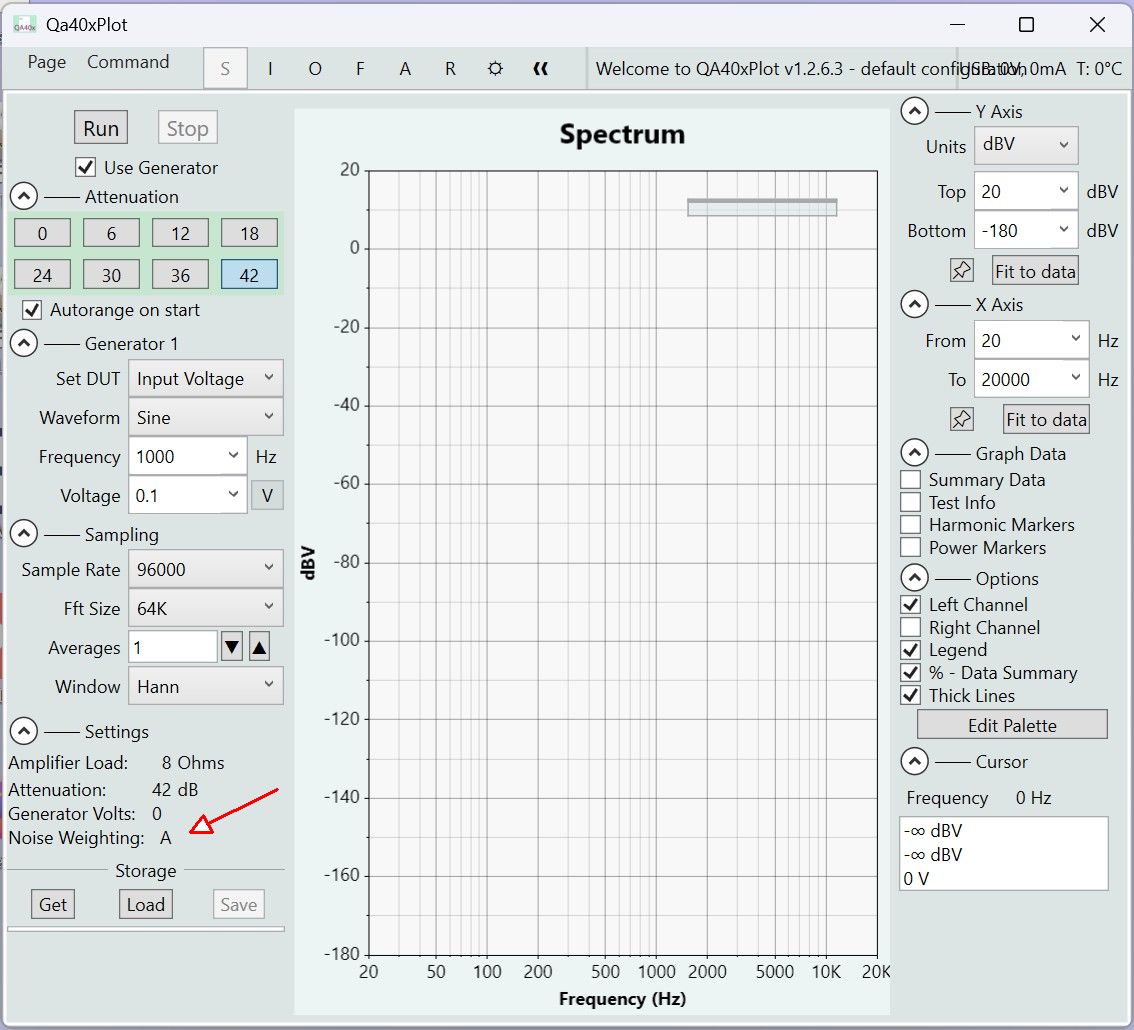
c.) The A and C weighting filters need to be chosen on the settings page.
While it appears logic at first, it would be more useful if the filters could be set directly at the measurement pages (like the Spectrum or Amplitude-response).
As the setting list appears on the measurement display, maybe a click on the filters entry could open the setting, like it is done in the original QA40x App.
But so far I like Your software …. auto-ranging and invers-RIAA chirp are a big plus for me 
Calvin
I’d be curious what network you built. I went out and bought a preamp but a nice passive network would be great.
Chirp comments: chirp has more imprecision the more octaves you test and as it nears the frequency ends partly because the RIAA gain is so high that the voltage range is substantial and the high frequency samples are tiny. I’ll see if there are ways to improve it a lot but…
The swept test should be very precise so I haven’t fussed the chirp much.
The specified chirp value should be attained at approximately the maximum chirp frequency. The intent is to ensure none of the chirp is greater than your request so you can set attenuation manually. I haven’t tried to get that exactly right and since the gain is also calculated from a chirp it’s doubly tough.
I’ll look into the crash while changing chirp definition.
It’s easy enough to add weighting selection (at the cost of screen real-estate). Are you talking about the frequency response test? Don’t you always want that unweighted?
I’m happy to get some RIAA feedback. You’re the first : )
Mark
Hi,
these are my measurements of my inverse-RIAA network.
It´s an old one with through-hole components and switchable MM-MC and switchable source impedances of 0R-50R-550R-600R.
I´ve made a second one in SMD, just fixed 50R source impedance and switchable MM-MC, which is even slightly more precise around 100Hz and gives smoother MC-response, due to double screening.
I didn´t use them for a while, since it was almost impossible to get air-borne power-line hum artefacts out of the signal.
The software based inv-RIAA has a advantage here.
Even for MC-levels aound -60 to -70dB@1kHz there are now almost no power-line artefacts.
Just a lot of EMV related switching stuff still messes things up if you don´t screen carefully and massively.
Here are the pics:
inv-RIAA old
Associated schematics
made a PCB, but Veroboard suffices also.
MM -40dB@1kHz amplitude response
MM -40dB@1kHz deviation form Highres-RIAA-File
MC -60dB@1kHz amplitude response
Mc -60dB@1kHz deviation form Highres-RIAA-File
Regarding the user-Filter setting:
It´d be nice and conveniant if the read-only “Noise weighing:” in S- and I-workspace could (also?) clicked and be set there, instead of just on the setting-page
Calvin
ps. I did also comparative measurements of my inv-RIAA boxes to Your softeware inv-RIAA-Chirp.
Just gimmy a couple of days.
btw: the Zout of the inv-RIAA boxes are 600R for MM and 60R for MC 
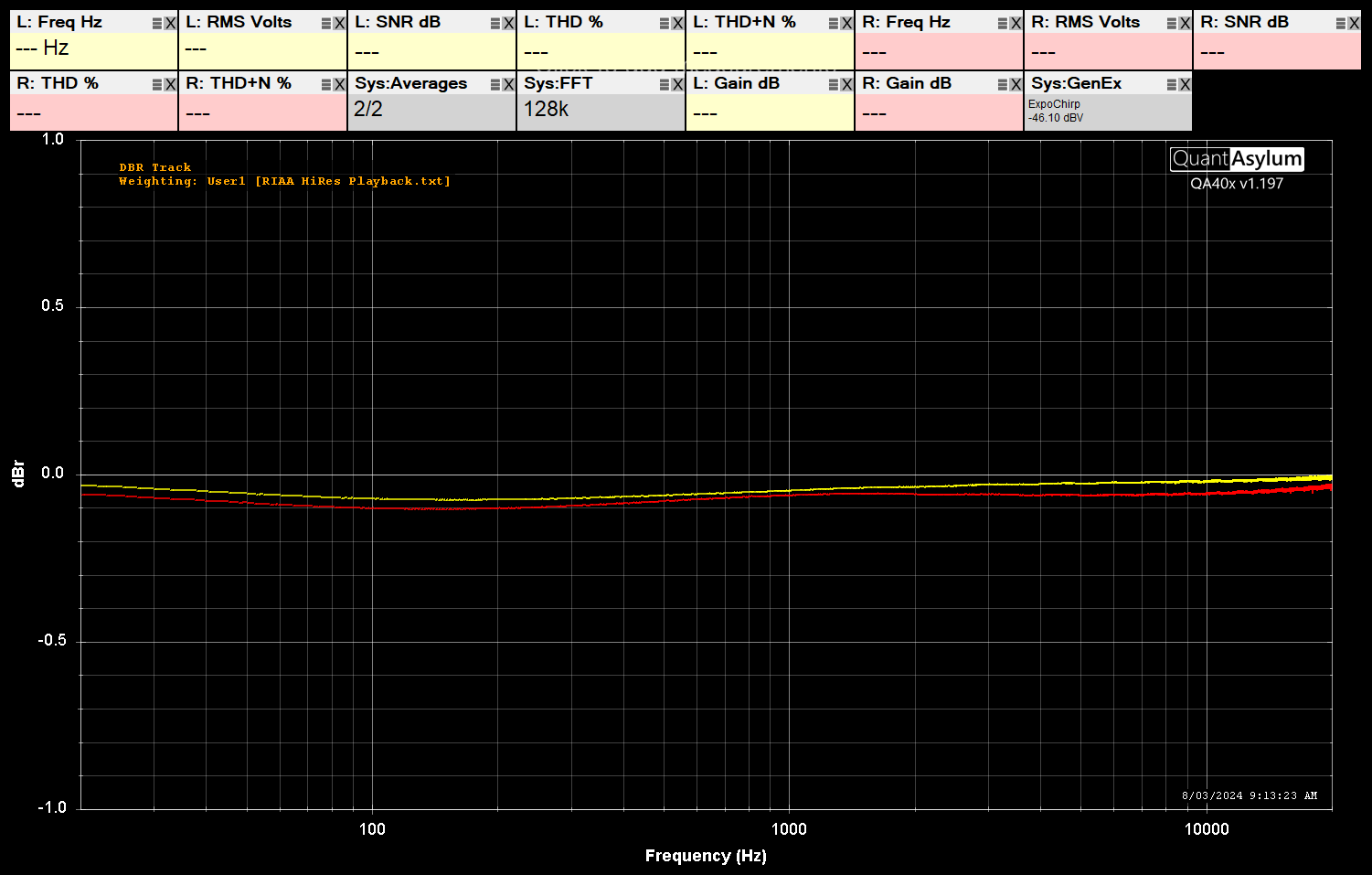
Here’s an example of the RIAA deviation using the hi-res file and the QA40x software into an excellent MM preamp stage from a 1983 Denon preamplifier.
Back on the old 1.197 software.
Notice the +/-1dBr scale. Less than 0.1dB deviation from 20-20k. I have others, but that is an example of what can be done and demonstrated.
@Calvin You should look at your inverse RIAA at HF- something is seriously wrong IMO. Do a loopback with the QA40x software (with RIAA) and see where you stand.
I’m not sure what I’m looking at here. It looks like you’re doing a special weighting curve on output. Is that right? If so, that’s pretty different from pre-emphasis and you can do that exact thing in QA40xPlot by doing a frequency response test and using the inverse riaa as a microphone compensation file.
Here’s a plot comparing the flat swept vs flat chirp using the same QA40x high res riaa file as microphone compensation with my Fosi preamp. I set the chirp to 10→30KHz and 512K samples and 0.1 smoothing.
I support that method but personally prefer the preemphasis because the supply voltage mimics a playing album and there’s phase output. I don’t support a user-weighting file (for use with gain or spectrum) but I’m having second thoughts.
Here’s a comparison of the RIAA preemphasis versions. This uses less chirp smoothing but again shows about .4dB error at 20KHz with excellent precision otherwise. The chirp is in purple.
Hi,
this is a comparative simulation of my inv-RIAA Box, the ideal Laplace-inv-RIAA and ideal Laplace-inv-RIAA-Neumann.
Results are deviations of a couple of 10th-dBs.
Delta@20kHz: inv-RIAA(out) to Laplace-inv-RIAA: -0.34dB
Delta@20kHz: inv-RIAA(out) to Laplace-inv-RIAA-Neumann: +0.30dB
Delta@20kHz: Laplace-inv-RIAA to Laplace-inv-RIAA-Neumann: -0.64dB
Zoomed-in diagram
My inv-RIAA box falls right between the ideal RIAA and ideal RIAA-Neumann curves.
In praxis for Phono-stages with RIAA-emphasis I get roundabout -0.6dB to -0.8dB @20kHz and almost ±0dB with RIAA-Neumann emphasis.
Let´s not forget, that -while the so called Neumann emphasis at playback is something one can argue about- the Neumann preemphasis was factually implemented as a second order lowpass at 50kHz (iIrc), and it results in a small drop in amplitude response of RIAA at HF.
Also, MM-Pickups react considerably on the input impedance of the Phono stage´s input.
Add to this the mechanical lowpass filter of the pickup, it´s mechanical resonance of cantilever and needle, etc. and You hardly ever get a exact linear response.
Not least is the standard MM-dummy-pickup for measurements 600R+600µH,
Measuring a Phono-stage without sufficient source impedance will also result in ampltude deviations.
Calvin
Thanks for that. fwiw I don’t use the Neumann pre-emphasis because the Fosi clearly doesn’t have it and the AudioScienceReview review of the Fosi doesn’t use it. The code is in QA40xPlot but I turned it off after testing the Fosi. I could add it as an option in Settings.
Mark
Hi
intersting posts
I will double check with my AP where I have a ultra-precision Riaa test
Walter
There’s either pre-emphasis curve on the signal you are driving the DUT with, or a de-emphasis curve on the signal output from the DUT.
The QA40x software does de-emphasis (basically a weighting curve, but a very precise high resolution RIAA one).
It really doesn’t matter which way you go when you think about it.
a) the excitation signal is the rated input for full scale output (usually (MM) ~2.5mV)
and b) the very worst phono stage I’ve ever tested had a 50mV@1kHz overload which is still 26dB over 2.5mV, allowing 6dB headroom over the 20dB boost at LF from the RIAA curve.
If you do it as pre-emphasis on the output of the analyzer, you’ll be pulling the low frequencies down by up to 20dB from an already low 2.5mV. That may make for a noisy low end deviation trace at 250uV.
The only time a de-emphasis curve might bite you is a high level sweep which could overload the phono stage at LF, but I’ve never had that. You don’t deliberately try to overload when doing an RIAA deviation test.
Good vintage phono stages have 200mV+ overloads @1kHz are are remarkably accurate when it comes to RIAA deviation. I used to use an outboard inverse RIAA network/attenuator, but the QA40x software along with the internal attenuators and hi-res RIAA curve has completely obsoleted that.