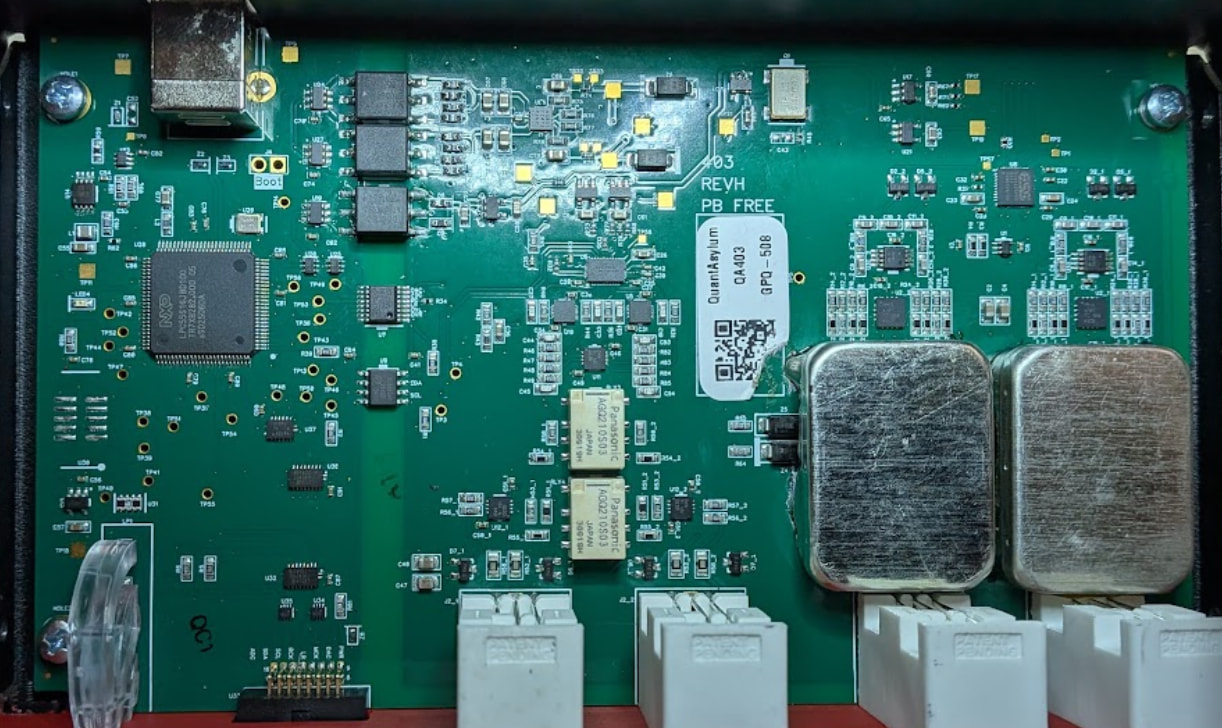
Thank you for the quick response. I love the product but was not expecting the issue with the attenuation increasing the 60hz hum by 43dB at above 24dB attenuation. I will try to avoid using these ranges in the future.
I am thinking of adding some internal shielding to the input section to see if that helps. There are many commercial cans that can be acquired rather easily and do not cost a fortune. I used these in some other designs.
the Signal Path showed the insides . Uses AGQ210S03 relays.
Hi @kawal, I’m not sure those shields would work. For powerline, and steel shield probably has a skin depth of 2mm, and so the 0.5mm thick shield might not be enough. You really should be able to get rid of the power line by smartly positioning the QA403 away from large transformers and high-power ACDC converters. You’ve shown that in the one picture you posted where the powerline was at -105 dBV or so.
Just trying to see if improvements can be made. I really appreciate what you have made here. A great piece of gear . I found a stash of shields . They a not a perfect fit but should work. A notch is needed for the caps and another for the TVs diodes and a third for the op amp.
I did a little experiment with my setup. I use an XLR front for my qA403. So, I tried three different loopback setups.
standard loopback with XLR female out → rca → barrel connector → rca → XLR male in
same as (1) with a thinnish 6x18 steel plate under the QA403 and cabling (assuming most of the 60Hz comes from the floor). This barely is wide enough for the QA403 box.
same as (1) but instead of a typical RCA → XLR male I used a 2-wire shielded cable where the rca connector ground goes to the other input line (pin 3) instead. The XLR shell goes to the cable shield which stops just before the RCA connector.
The results were very consistent through a few runs. (1) showed a bunch of hum and some other signals. (2) showed (marginally but distinct) less hum and others. (3) was near perfect with no visible hum
I tried one more test where I rotated the steel plate so it was only under the QA403, not the cabling, and not surprisingly this was identical to test 1.
Did you connect the pate to the chassis of the QA403 ? or just a stand alone plate. The stand alone plate would not help. Needs to go to chassis ground or signal ground.
I did not connect it to ground. So I tried again with a ground wire and the two results are identical (with and without ground). It’s not the best test in the world as the plate is much too small and the ground wire impedance is high (here).
I’d rather try with a sealed mu-metal box but yeah that’s not a thing for $600. I do think the idea of using the two ports of input as balanced has merit.
I’ve spent way too much time soldering custom BNC cables trying to fix this exact issue. Seeing that the fix might just be a solid ground reference (and keeping the unit away from power bricks) is a lifesaver.
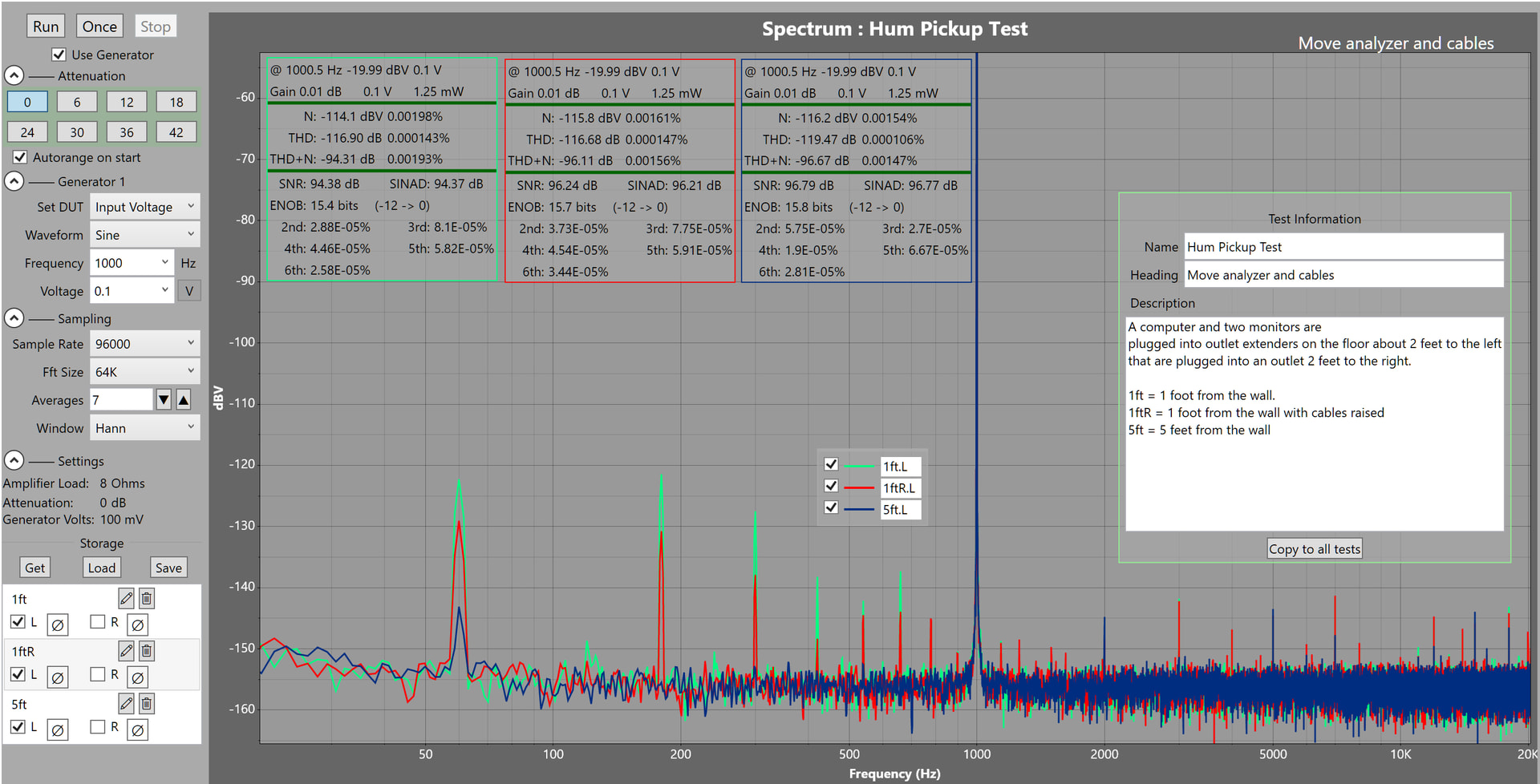
The simplest and fastest way to get rid of 60Hz and harmonics I’ve found is to move the analyzer and cables and DUT as far from wall/AC as possible. Next, there are issues with large appliances/motors running and generating random rfi farther than you would expect - so like I turn off air conditioners during serious tests. Really bad are some bright/cheap LED tripod lamps within a few feet (even if they’re not turned on - thanks to power bricks).
Here’s a plot with two loopback connections using bnc/coax. I’ve done nothing here but move the unit/cable from one table to another. The USB cable was left in/on the whole time.