G’day Fellow members,
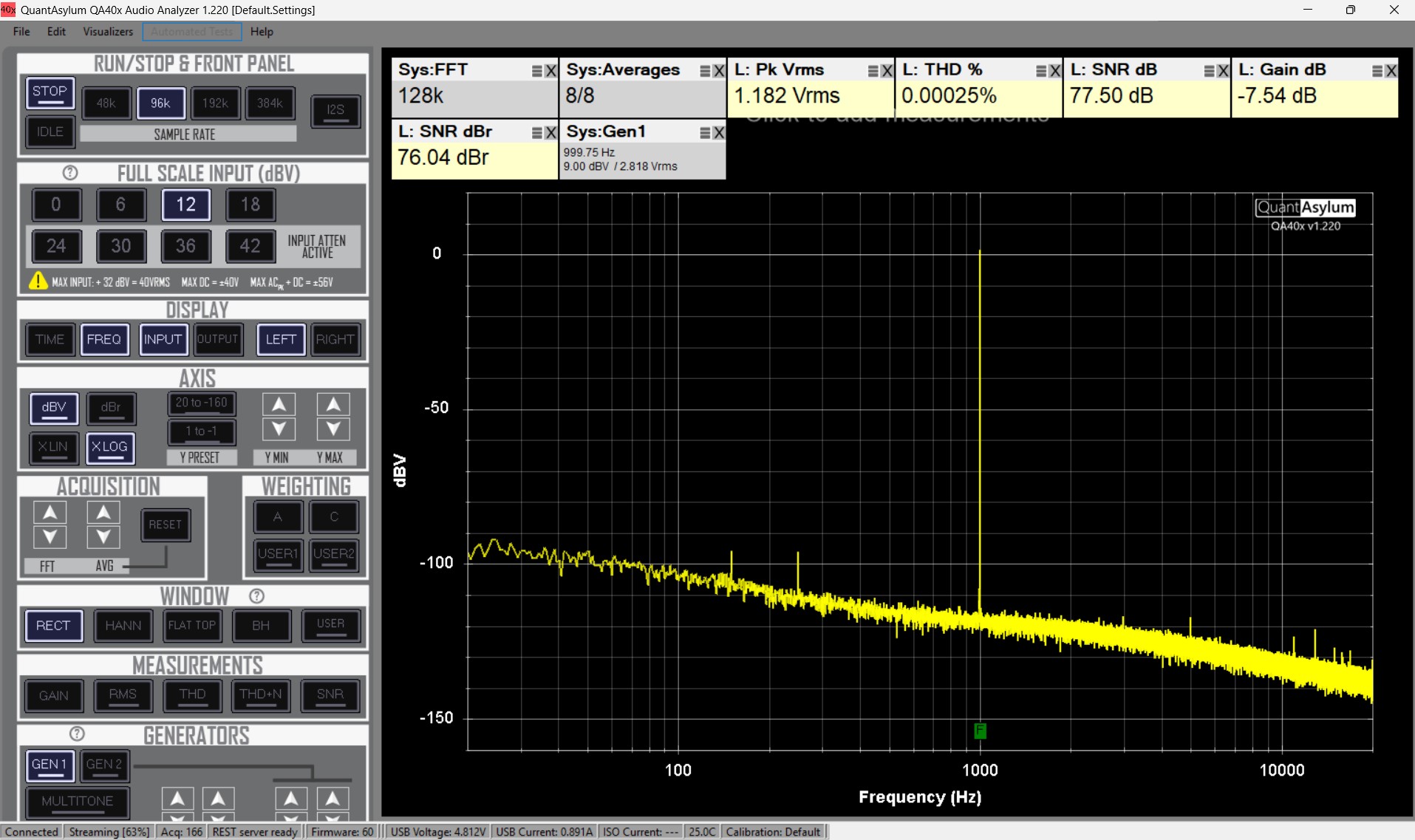
Okay I am going to show my measurement ignorance here. Please see the below pic of a plot from measurements on a MC phono stage I am building. Why is the snr only 71.09db?
G’day Fellow members,
Okay I am going to show my measurement ignorance here. Please see the below pic of a plot from measurements on a MC phono stage I am building. Why is the snr only 71.09db?
@totaltech I would say your MC phono stage looks pretty darn good compared to what I see in the older gear I see. Very clean and I would be very happy with an SNR of 71dB. It will improve if you apply the RIAA weighting- load under User1 or User2. I don’t know what the “rules” are for applying the RIAA weighting when showing THD/SNR plots- I typically show it both ways, but always show Frequency Responses with it applied.Edit- I did ask the Google AI about this and it said it was acceptable to show the thd/snr plots with the RIAA weighting applied…Plus it showed a whole thread in this forum from 3yrs ago related to RIAA …
SNR is signal power divided by noise power - the sum of all the noise across the audio band is a lot higher than the noise in one FFT bin, which is what the spectrum plot shows.
For instance if the FFT bins happen to be 1Hz wide and you use a rectangular window, you’d have 20000 bins across the audio band, so if each bin showed -120dBV (1µVrms), the combined noise would be √20000 times that or 141µVrms (-77dBV). If the bins are a different width you have to correct for that, and if a different window you have to correct for the effective noise bandwidth of the window.
Also here the noise floor isn’t flat/level so you integrate over the frequency range, you can’t just scale by the number of bins.
Hi totaltech,
your preamp perfoms very well, congatulations! Please note that the QA403 has an output impedance of 100Ohm. The noise of a 100Ohm resistor is 180nV for a 20kHz bandwidth. The best you can get for a 1mV input signal is 74dB SNR. I assume your input stage uses bipolar transistors generating input noise current. This current noise and the QA403 output impedance generates additional noise voltage.
I think the QA403 output stage is not optimal to output a 1mV output signal. I suggest you use a 60dB passive attenuator (10kOhm + 10Ohm). Like this, you can set the QA403 output to 1V and you have a lower source impedance of 10Ohm.
It is very interesting to see the progress of your project.
Best regards
Andy
This is exactly right. At 1mV output, the attenuators are on, inside the QA403 (gen side) and he is applying 60dB of gain to the inherent noisefloor of the generator.
His result is very good for MC regardless.
Two other factors can also affect the SNR value: 1) the “reference” signal level. Here you are using 0dbv (1vrms). Some companies use 2vrms, for example - a 6db improvement (on paper!). 2) whether you are using “A” weighting. This can be huge, well over 10db depending on where the noise is. Low frequency noise as you typically get with MC amps is greatly attenuated in that weighting and makes the numbers look so much better.
Here’s a spec sheet for a current Schiit preamp (solid state) for some relevance. Check out the 60db gain setting (a typical MC value). It uses both “A” weighting and 2vrms (single ended) for reference.
https://www.schiit.com/products/skoll-f
Concur with others that your MC amp looks great!
Thank you everyone for your advice and kind remarks!
This MC pre is not my design, the original thread is below for anyone interested. I was measuring this to get myself familiar with RIAA measurements with the QA403. Now I am happy with results, I will build my valve (tube!) preamp and measure it.
I did one final set of measurements using an inverse RIAA network from Hifisonix.
Above plot showing the measured inverse RIAA accuracy.
Above plot showing the MC preamps deviation from the IRIAA curve - +/- 0.35db.
And finally the SNR and distortion measured using the inverse RIAA filter.
@totaltech You can use the hi-res RIAA playback weighting in the QA40x software too.