Verifying Calibration Automatically

Release 1.221 is up HERE

This release has a new feature that is discussed HERE

This allows you to generate a calibration report for your QA40x hardware if you have a recently calibration 6.5 digit DVM. You really do need a 6.5 digit DVM and a recent calibration certificate to take advantage of this new feature.

When you run through the steps, you’ll get a report that looks like THIS. And at the bottom of that report, you get a statement similar to this (it will be different for every unit).

If we conservatively add the worst-case linearity deviation to the worst-case absolute error from the DVM checks, we obtain an overall upper bound on level accuracy of roughly ±0.39% over the region from about 50 dB below full-scale input up to full-scale. In practice, typical errors will be smaller than this bound.

If you are working in a manufacturing or development environment and you need amplitude measurement confidence, traceable to a DVM with a recent calibration certificate, this feature will hopefully help.

A 6.5 digit DVM with a recent cal certificate will help you understand absolute errors. But you can also look at relative errors if you don’t have such a DVM. Just use some reasonable defaults, and enter exact voltages (no error) in the steps where it asks for DVM readings, and you’ll see be able to generate the plot below, which should give you confidence is the relative performance of the instrument over all input and output ranges.

When time permits, please share your runs below and/or comments on the test procedure. This is a first step. In the coming weeks, the aim is to run this on a lot more units at 15C, 25C and 35C.
1 Like

Hi @matt. I find the new software release very interesting. In particular, I find that the ability (with a recently calibrated 6.5-digit DVM available) to verify and generate a calibration report for the QA403 is a significant step forward in terms of the accuracy of the measured values. Ideally (but I don’t know if this is easy to achieve), this data could be used to recalibrate the QA403 once the original factory data has been saved, so that it can be restored if the recalibration fails or does not provide satisfactory results. If this option could be implemented, it would be another big step forward for the QA403 software. Thank you.

Excellent update @matt and absolute kudos looking into the S/N investigation and resultant tweak of the QA40x software.

Some major fixes in this update. I am super impressed - thank you.

@Claudio and @restorer-john, glad this is helpful!

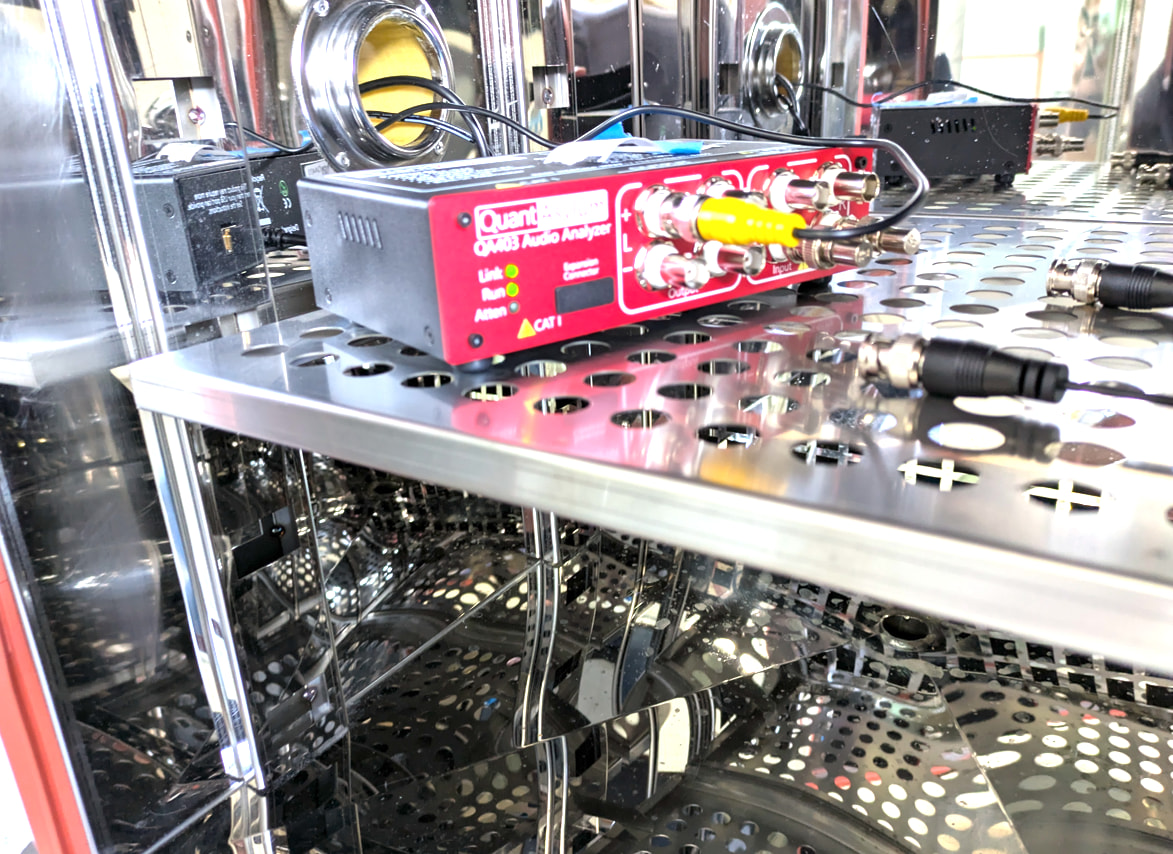
Attached are 4 PDFs of the same randomly sampled unit, measured in the temp chamber at 15C, 25C, 35C and 45C.

The DVM was kept outside of the chamber for measurements. Soak time was 10 minutes once temp stabilized in the chamber.

15C Cal Verification.pdf (367.8 KB)
25C Cal Verification.pdf (368.5 KB)
35C Cal Verification.pdf (372.1 KB)
45C Cal Verification.pdf (368.4 KB)

We can plot the DVM-measured voltage at the 4 temperatures (2V scale) and see the linearity is good, and tempco is about 10ppm/C, or about +0.00008 dB/C. Overall, this is much better than most thin-film resistors.

We can see the IO linearity at 15C:

And 25C:

And 35C:

And 45C:

You can see that the IO linearity (which is errDb = measuredAmpDb - outputAmpDb) shifts from perhaps 0.005 dB high to 0.02 dB low as we move from 15C to 45C.

Given we know the DAC tempco (confirmed by the DVM) is about 10 ppm/C (0.00008 dB/C), this suggests the ADC side dominates. We see over a swing from 15 to 45C, the error shifts from +0.005 dB to -0.02 dB, which is about -0.0008 dB/C = ~96 ppm. Thin-film resistors can have tempcos ranging from ±100 ppm to ±10 ppm.

Finally, if we tabularize the estimated error from the report for each temp we get:

Temp (C) Worst-Case Amplitude Error
15 ±0.4%
25 ±0.43%
35 ±0.53%
45 ±0.64

Remember, the errors are the expected combined max errors from -50 dB below full scale to full scale or +18 dBV (the limit of the hardware).

In general, as the unit gets colder, accuracy seems to get a bit tighter. Note that ±0.4% is about ±0.034 dB. And as the unit gets warmer, accuracy seems to get a bit looser.

Roughly, we might summarize the above by stating that on this particular unit, it seems the worst-case amplitude error would be quite a bit better than ±1% at temperatures you might experience in both an office building or a warm factory in Asia.

There will be unit to unit variations. And the error bars shouldn’t be taken to mean anything other than a rough guide of what might be commonly achieved.

2 Likes

Hi @matt. I find the results obtained and summarized in this table very interesting. I believe that the variation in the “Worst-Case Amplitude Error” of (in absolute terms) 0.24% for a deltaT of 30° is definitely good. It would be interesting to repeat the same tests to re-evaluate the same error after a period of time (e.g., after 6 months and after 1 year of use), in order to understand the effect of component aging on the unit under test. However, in light of these values, I consider the QA403 to be a very reliable product in terms of the values it is able to measure and therefore represent. Thank you, Matt, for all this work.

Here is a run of my unit at 24C (ambient) I don’t have a temp chamber but my work room has HVAC year round, so the temperature does not vary much. I used the 1 year numbers on the DVM as it has been a while since calibration. I intend to get it calibrated soon and will rerun with the shorter term numbers.

Calibration Report

It would be great to expand this to more than one frequency (optionally). Actual calibration updates would also be welcome. Even better, automated reading of the external DVM although they are likely all different.

Regards,

Mark